
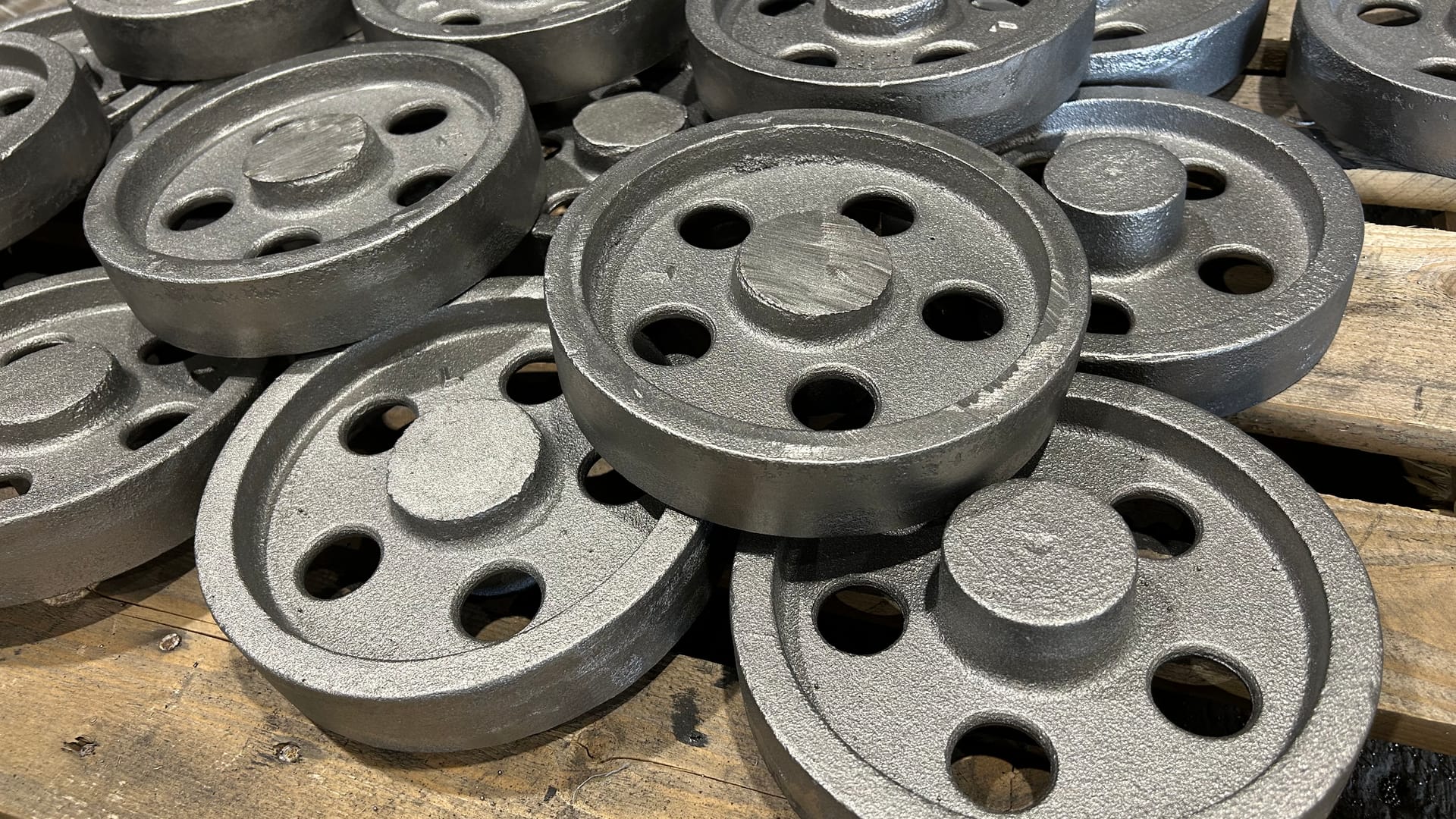
Gray iron and ductile iron are both cast irons, but each has different applications. The material and grade on a casting drawing establish the strength, ductility, machinability, and service performance the finished part must deliver. For engineers and buyers sourcing a new casting or replacing an existing one, these specifications determine what the foundry must produce.
Gray Iron & Ductile Iron Microstructure
The primary difference between the two materials is the form of graphite within the iron. Gray iron contains graphite flakes, which provide vibration damping and machinability but create internal stress concentrations that limit tensile strength and ductility. Ductile iron is treated with magnesium while molten, causing the graphite to form rounded nodules. The nodules reduce stress concentration, giving ductile iron higher tensile strength and the ability to deform before fracturing.
Ductile Iron vs. Cast Iron: Property Comparison
The table below compares typical properties of the two materials. Values for a specific casting are based on the grade, section thickness, microstructure, and operating conditions.
| Property | Gray Iron | Ductile Iron |
|---|---|---|
| Graphite structure | Flakes | Rounded nodules |
| Common ASTM specification | ASTM A48 | ASTM A536 |
| Tensile strength | Lower | Higher |
| Ductility | Very limited | Greater; varies by grade |
| Vibration damping | Excellent | Lower |
| Thermal conductivity | Higher | Lower |
| Machinability | Excellent | Good; varies by grade |
| Typical material cost | Lower | Higher |
Grade Selection & Specification
Specify gray iron for pump casings, machine bases, gearbox housings, and other components where vibration damping, machinability, and dimensional stability matter most. Components exposed to higher tensile loads, bending loads, or mechanical shock call for ductile iron, including pump and valve components, brackets, supports, and hydraulic equipment.
The specified grade establishes the minimum mechanical properties necessary for a casting. For example, ASTM A536 65‑45‑12 and 80‑55‑06 are both ductile iron grades, but they have different strength and elongation. Specifying the correct grade is important to producing a casting that meets the application’s requirements.
Material Substitution for Existing Components
Converting a gray iron component to ductile iron requires reviewing the original design and its operating conditions. Ductile iron has greater tensile strength and ductility, and the change also affects vibration damping, thermal conductivity, and machinability.
The reason for the change determines whether it is worthwhile. A gray iron component that has performed reliably for years often gains little from a different material. A component with repeated failures needs a confirmed cause before the specification changes. Whoever is responsible for the component’s design should review and approve any substitution.
Material Identification for Older Castings
Buyers sourcing replacement castings for older equipment often find that the original drawings and material specifications are no longer available. Purchase records and material certifications are the first sources to review. When no records exist, metallographic examination identifies gray or ductile iron from the graphite structure, and additional testing and engineering review inform the replacement specification.
Lake Foundry develops or adapts tooling from existing patterns, core boxes, casting drawings, 3D models, or physical components. We evaluate replacement castings even when the original drawings or tooling are no longer available. Learn more about our Emergency & Replacement Casting capabilities.
Gray & Ductile Iron Castings at Lake Foundry
Lake Foundry specializes in complex, low-volume gray and ductile iron castings for OEMs and industrial customers, from individual castings to recurring programs involving multiple part numbers. Here is what we offer:
- Finished casting size: Up to 12,500 lb in gray iron and up to 3,500 lb in ductile iron
- Pour capacity: Up to 15,000 lb of gray iron and up to 6,000 lb of ductile iron
- Pattern making: An in-house pattern shop producing foam and wood patterns, with aluminum and 3D-printed patterns also available
- Molding: No-bake sand molding for large, complex iron castings, from one-off components to recurring low-volume production
- Quality: Production under an ISO 9001:2015 certified quality management system
Frequently Asked Questions
Can the same iron grade have different properties in different casting sections?
Yes. Section thickness affects cooling rates and microstructure, which could influence mechanical properties. Thick and thin sections of the same casting could perform differently, even when produced from the same melt, which is particularly important for large castings with complex geometries.
Are ductile iron, nodular iron, and SG iron the same material?
Yes. Nodular iron and spheroidal graphite (SG) iron are alternative names for ductile iron.
Can an existing gray iron casting be identified without a material specification?
No. Metallographic examination distinguishes gray iron from ductile iron by identifying the graphite structure, but additional testing may be needed to determine mechanical properties and establish an appropriate replacement specification.
What does ASTM A48 Class 30 mean?
ASTM A48 Class 30 specifies a minimum tensile strength of 30,000 psi, measured on test specimens the standard defines. Properties within a finished casting vary with section thickness and cooling rate.
Can an existing pattern be used when changing from gray iron to ductile iron?
Possibly, but review the pattern and core boxes before production. Differences in solidification behavior, shrinkage, and other casting requirements could require tooling modifications.
Request a Quote
Lake Foundry reviews gray and ductile iron casting requirements for new and existing components. Submit any available drawing, material specification, 3D models, or part details for review.