
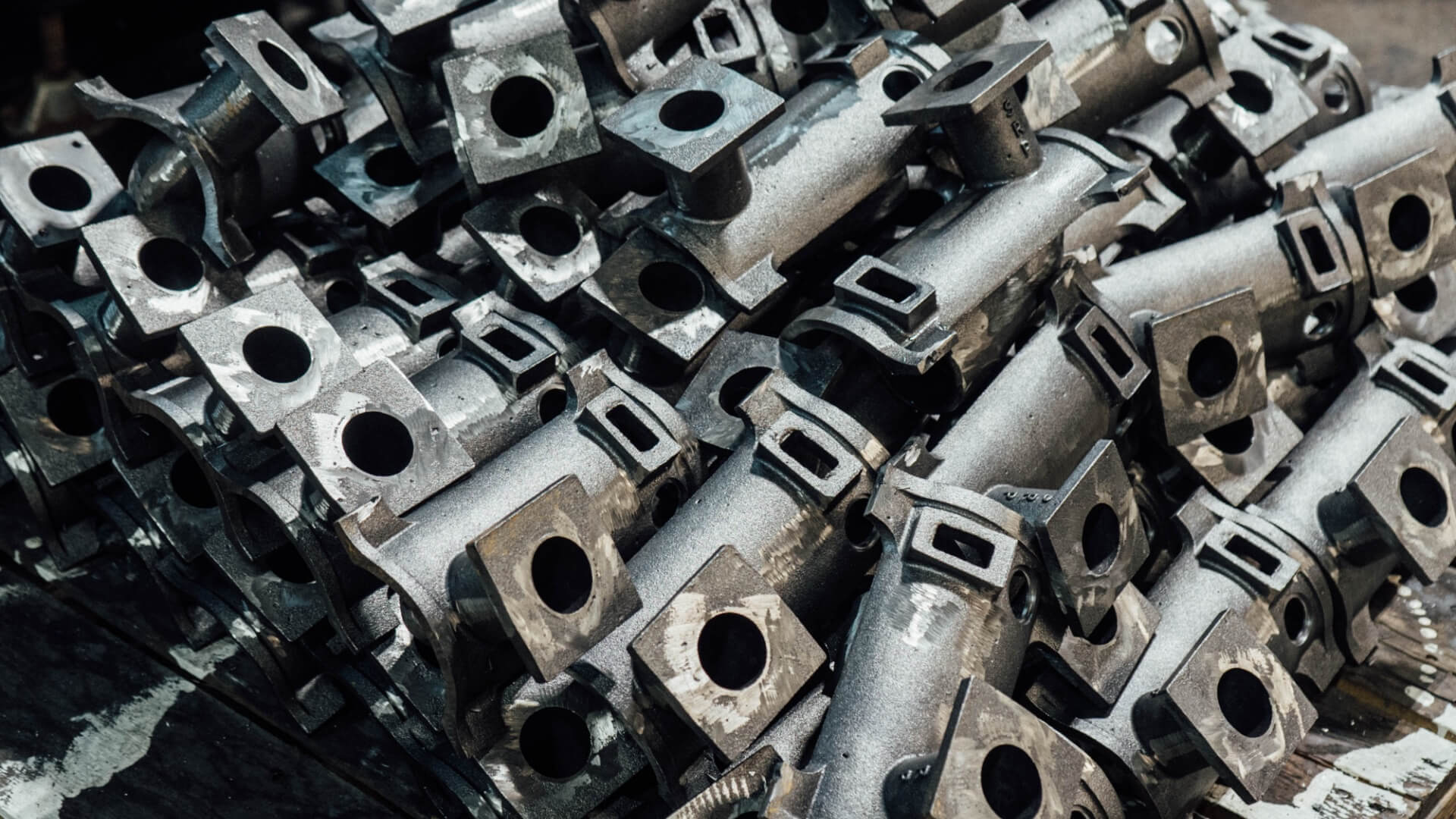
A pump casing drawing that calls for ASTM A48 Class 30B tells the foundry what to pour, while an older mill drawing that says only “gray cast iron” leaves the class open. Either way, the class is the customer’s decision, and Lake Foundry can offer guidance. Moving from Class 30 to Class 40 adds strength at some cost to damping and machinability. Which class fits your part depends on what it does in service and how thick its walls are.
What the ASTM A48 Class Number Means
The class number is the minimum tensile strength of a separately cast test bar in thousands of psi, which means Class 30 requires at least 30,000 psi. A letter after the number, as in Class 30B, sets the bar size to match the casting’s controlling section.
ASTM A48 sets tensile strength as the requirement and leaves chemistry to the foundry, meaning a class callout does not control composition, hardness, or microstructure. If your design needs a hardness range for wear, write it into the drawing or the purchase order.
Gray Cast Iron Properties in Class 30, 35, & 40
As the carbon equivalent of the melt drops, the iron forms fewer, finer graphite flakes in a stronger matrix, raising strength and stiffness while reducing the damping and free machining the flakes provide. The ASM Handbook chapter on gray iron castings covers these relationships in detail.
| Property | Class 30 | Class 35 | Class 40 |
|---|---|---|---|
| Minimum tensile strength | 30 ksi (207 MPa) | 35 ksi (241 MPa) | 40 ksi (276 MPa) |
| Elastic modulus (stiffness) | Lowest | Intermediate | Highest |
| Vibration damping | Highest | Intermediate | Lowest |
| Machinability | Easiest | Intermediate | Slowest |
| Thermal conductivity | Highest | Intermediate | Lowest |
| Shrinkage tendency | Lowest | Intermediate | Highest |
Comparisons are relative within these three classes and vary with chemistry, section thickness, and cooling rate.
Why a Higher Class Is Not Automatically the Better Choice
Specifying Class 40 for extra margin changes how the casting is poured, because Class 40 iron, with its lower carbon equivalent, forms less graphite to offset shrinkage and needs more feeding in heavy sections. On a pump casing, where leaking is the main quality concern, an underfed section can leave shrinkage porosity in a pressure-holding wall. Compared with Class 30, Class 40 is more likely to chill in thin-walled sections, which raises hardness and makes machining more difficult.
On a part that sits under rotating equipment, absorbing vibration can matter more than the extra 10 ksi, while higher sustained loads favor the strength of Class 35 or 40. When a part has failed in service, find the cause before raising the class, as the fix may be a design change or ductile iron.
How Wall Thickness Changes As-Cast Properties
Because gray iron is section-sensitive, a thick wall in cast iron sand casting cools slowly, forms coarser graphite, and ends up weaker than a thin wall poured from the same ladle. ASTM A48 addresses this with the test bar letter, although it notes that no precise relationship exists between test bar and casting properties. The purchaser picks the bar that matches the controlling section:
- A bar, 0.88 in. diameter, for sections of 0.25 to 0.50 in.
- B bar, 1.2 in. diameter, for sections of 0.51 to 1.00 in.
- C bar, 2.0 in. diameter, for sections of 1.01 to 2 in.
- S bar, sized by agreement, for sections under 0.25 in. or over 2 in.
Large castings often have sections over 2 in., and for those the S bar size should be agreed before ordering. When a job calls for separately cast test bars, we pour them and run the tensile and hardness testing in-house. Material certifications are provided on request, ideally at order placement.
When the Drawing Gives No Class
A replacement for older equipment may arrive with a drawing that gives no class, or with only the worn part. If your drawing does not specify a class, we will pick up the phone and walk through how the part will be used. We ask whether it takes impact, whether it moves or stays stationary, what heat it sees in service, and whether it needs further processing, and your answers shape the class we suggest for your approval.
Old purchase records sometimes name the original class. When they do not, a metallurgical laboratory can confirm the iron type and use hardness and chemistry results to estimate it, which gives the customer’s engineer a basis for approving the replacement specification.
If the pattern is gone too, we can reverse-engineer the part and build new tooling in our pattern shop, which takes longer than working from a drawing. Learn more about our Emergency & Replacement Casting capabilities.
Solved: 1,900 lb Gray Iron Replacement Without a Drawing
A customer needed to replace a worn 1,900 lb gray iron casting with no original drawing. We reconstructed the geometry from the existing part, accounted for wear, and built a new pattern. Because we already knew the customer and the application, the replacement shipped 2½ weeks after the purchase order.
When to Move Up to Ductile Iron
Ductile iron, whose rounded graphite nodules allow far greater elongation, is the better material when a part takes impact or shock loading or needs more strength than Class 40. ASTM A536 grade 65‑45‑12, a common ductile grade, requires 65,000 psi tensile strength and 12% elongation. Switching gives up some damping, usually costs more, and calls for a review of the existing pattern, since the two irons solidify differently. Our article on Ductile Iron vs. Gray Iron compares them in detail.
Gray Iron Castings at Lake Foundry
Lake Foundry has made iron castings in Grimsby, Ontario, since 1955, and our work focuses on large, complex castings for low-volume, high-mix programs. We pour gray iron castings to ASTM A48, A126, A278, and A319, and we do not change the grade on an established part without the customer’s approval. When a pump or mill line is down, lead time often decides which foundry gets the order, and keeping pattern making in-house helps us control that schedule. Here is what we offer:
- Finished casting size: Up to 12,500 lb in gray iron and up to 3,500 lb in ductile iron
- Pour capacity: Up to 15,000 lb of gray iron and up to 6,000 lb of ductile iron
- Pattern making: An in-house pattern shop producing foam and wood patterns and evaluating existing tooling
- Molding: No-bake sand molding, from one-off castings to recurring low-volume programs
- Lead times: Typical programs run 4 to 6 weeks, and emergency work can be as short as 1 to 2 weeks
- Quality: Production under an ISO 9001:2015 certified quality management system
Frequently Asked Questions
What is the difference between ASTM A48 and A48M?
A48M is the metric companion to A48, and its class numbers give minimum tensile strength in MPa, such as Class 200 and Class 250. Because the metric classes are not exact conversions of the inch-pound classes, the drawing should name which standard applies.
Is grey cast iron the same as gray cast iron?
Yes. Grey is the spelling common in Canada and the UK, and gray is the American spelling used in ASTM standards.
Is gray iron the same as cast iron?
No. Gray iron is one type of cast iron, along with ductile, white, and malleable iron, although many older drawings use “cast iron” to mean gray iron.
Request a Quote
Lake Foundry reviews gray and ductile iron casting requirements for new and existing components. Submit any available drawing, material specification, 3D models, or part details for review.